
Summary:
Fungaroo instead proposed that the international community fully support South Sudan in the proper implementation of the 2018 Peace Agreement and called for the release of Dr. Riek Machar and all other opposition leaders and military officials who have been arrested in connection with the conflict.
KAMPALA: The Forum for Democratic Change Party (FDC) has criticized the deployment of the Uganda People’s Defence Forces (UPDF) in South Sudan, arguing that their presence is not aimed at implementing the peace agreement but rather at supporting one side of the conflict.
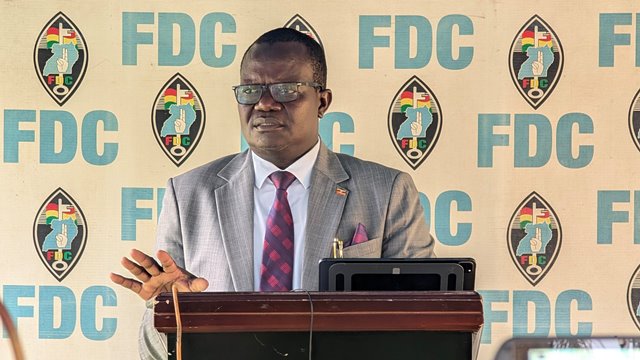
During a press briefing at the party headquarters in Najjanankumbi on Monday, Hon. Hassan Caps Fungaroo, the FDC Deputy President, stated that the party does not support the UPDF deployment to South Sudan.

Fungaroo instead proposed that the international community fully support South Sudan in the proper implementation of the 2018 Peace Agreement and called for the release of Dr. Riek Machar and all other opposition leaders and military officials who have been arrested in connection with the conflict.

He also urged the international community to strengthen the existing United Nations Mission in South Sudan (UNMISS) by upgrading it to a Peace Enforcement Mission.
Last month, Uganda deployed soldiers from the UPDF to South Sudan under “Operation Mlinzi wa Kimya,” a mission aimed at stabilizing the region amid a growing security crisis. Uganda’s involvement is part of regional peace-building efforts and remains critical in stabilizing South Sudan while ensuring civilian protection amid the ongoing conflict.
Uganda has previously intervened militarily in South Sudan, notably in 2013 and 2016. In 2013, Uganda sent troops to support President Salva Kiir’s government after civil war erupted between factions loyal to Kiir and Riek Machar.
The UPDF’s mission at the time was to protect Ugandan nationals, stabilize the situation, and safeguard vital infrastructure.
In 2016, Uganda intervened again when fighting broke out in Juba between Kiir’s forces and those loyal to Machar. During this intervention, Uganda played a role in protecting foreign nationals and assisting with evacuations. Uganda’s involvement in South Sudan has been driven by security and economic interests, aiming to prevent further regional instability.
South Sudan’s current crisis stems from a complex history marked by decades of conflict, political instability, and ethnic tensions. While the 2018 peace deal sought to bring stability, it continues to face significant challenges, including:
- The removal of Gen. Alfred Futuyo, Governor of Western Equatoria State, from office on February 10, 2025.
- Attempts by the South Sudan People’s Defense Forces (SSPDF) to arrest Western Equatoria Governor Lt. Gen. Karaba, which led to an exchange of gunfire at his residence in Yambio town, forcing the former governor to flee on February 10, 2025.
- The removal of National Health Minister Yolanda Awel Deng, a member of the armed opposition (SPLM-IO), on March 11, 2025, without an announced replacement.
- This removal escalated tensions between the SPLM, led by Gen. Kiir, and Dr. Machar’s SPLM-IO, leading to unrest in Western Equatoria, Western Bahr Al Ghazal, and Upper Nile states.
Notably, on February 12, 2025, SPLA-IO accused the South Sudan army (SSPDF) of attacking one of its cantonment sites during a “violent pursuit” of Karaba, whose whereabouts remain unknown.