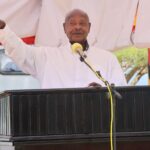
Deputy Chief Justice Moses Kazibwe Kawumi has pledged immediate action to address challenges affecting access to justice among refugees and the host community in Kiryandongo District.
Kazibwe made the commitment on Tuesday during a visit to Kiryandongo Magistrate’s Court as part of a justice sector engagement aimed at assessing challenges faced by refugees and their host communities.
He called for a comprehensive assessment of justice delivery challenges in Kiryandongo District and practical proposals for addressing them, following an inspection visit to Kiryandongo Chief Magistrate’s Court earlier today.
Justice Kazibwe directed the Chief Magistrate to coordinate the preparation of a comprehensive report, with input from justice-sector stakeholders in the district, detailing the challenges affecting justice delivery and proposing solutions for consideration by the Chief Justice and the Deputy Chief Justice.
The call followed discussions that highlighted the unique justice needs of Kiryandongo, including a rapidly growing population, a large refugee community, land disputes, language barriers, inadequate court infrastructure, juvenile justice challenges and shortages of personnel and equipment.

The Deputy Chief Justice was received by HW Abiti Samson Loum, Chief Magistrate, Kiryandongo, and HW Bridget Acidri, Magistrate, together with HW Faisal Umar Mulalira, Private Legal Secretary to the Deputy Chief Justice, and HW Brian Mwanja, Personal Assistant to the Deputy Chief Justice.

He was taken on a guided tour of the Court premises, including the chambers, offices, archives, exhibit room, registry, Court Hall and cells, before meeting Judicial Officers and stakeholders.
During the stakeholders’ meeting, Justice Kazibwe commended the Judicial Officers in Kiryandongo for their work and observed that the district faces unique challenges requiring locally informed and coordinated solutions.
He emphasised that the Courts, Police, Prisons, ODPP and other justice-sector actors cannot operate in isolation because effective justice delivery depends on cooperation across institutions.
The Deputy Chief Justice also commended non-governmental organisations operating in the district for supporting access to justice, particularly among vulnerable communities.
On infrastructure, Justice Kazibwe observed that the existing Kiryandongo Chief Magistrate’s Court premises were not designed to accommodate the needs of a Chief Magistrate’s Court.
He called upon the district leadership to explore the possibility of securing additional land adjacent to the Court to facilitate future expansion. With the district’s growing population and large refugee community, he noted that Kiryandongo could eventually require a High Court.
Language emerged as a significant access-to-justice concern, with the Court handling cases involving refugees who speak different languages.
Justice Kazibwe advised the Chief Magistrate to engage the Judiciary’s Human Resource Office to explore the recruitment of qualified local interpreters, stressing that language barriers should not prevent court users from effectively accessing justice.
The Deputy Chief Justice also pledged support towards ensuring that mediators in Kiryandongo are appropriately trained and certified as part of efforts to strengthen mediation.
He encouraged justice-sector stakeholders to become ambassadors of mediation and plea bargaining, noting that the two mechanisms can contribute significantly to timely case disposal.
Justice Kazibwe particularly called for intensified use of plea bargaining to address criminal case backlog and prison congestion.
During his visit to the Court cells, he interacted with inmates, and encouraged eligible prisoners to consider plea bargaining, explaining its potential to facilitate timely resolution of cases and enable Judicial Officers to manage heavy caseloads more efficiently.
He also emphasised coordinated enforcement of Court orders and the need for justice-sector institutions to respect and implement judicial decisions.
Briefing the Deputy Chief Justice, HW Abiti Samson Loum reported that Kiryandongo Chief Magistrate’s Court currently has a caseload of more than 570 cases
Kiryandongo District LC5 chairman Nelson Osaga welcomed the delegation, describing the visit as an opportunity for the district to present challenges affecting justice delivery.
Osaga said the district hosts more than 18,000 refugees, putting pressure on services and resources within the host community.
He asked the Judiciary to continue allowing mobile courts in the refugee settlement to bring justice services closer to communities.
He also called for training of sub-county committees to enable them to handle minor disputes appropriately before referring them to courts.
Osaga further requested the expansion of the magistrate’s courtroom, saying the facility is often overwhelmed by cases.
He said some minor disputes could be resolved through cultural and religious leaders, elders and local council leaders instead of being taken to court.
Owor Kennedy, a legal officer with the Refugee Law Project in Kiryandongo, said limited access to justice can have far-reaching consequences for individuals and their families.
He commended the police, prisons and Judiciary for supporting mobile courts in the district.
He said Kiryandongo Chief Magistrate’s Court has conducted mobile court sessions for the past five years, even before the Chief Justice issued practice directions on the matter.
According to him, the initiative is in line with the Judiciary’s objective of expanding mobile courts for refugees and host communities.
He said the Refugee Law Project, in partnership with UGANET, would conduct its second mobile court session of the year in Kiryandongo, starting Wednesday.
However, he identified challenges including limited understanding among judicial officers and other public servants of refugee documentation, such as registration cards and family attestations.
He said this sometimes results in refugees being charged without proper consideration of their documentation, while potential sureties may also be rejected because public officials do not recognise the documents.
He also said the arrival of refugees from Sudan presents additional challenges because of differences in culture and social practices.
The Office of the Prime Minister has so far designated Kiryandongo and Kampala as settlements receiving the new arrivals, he said, calling for increased support to ensure refugee-related justice concerns are handled effectively.
He urged the Judiciary to strengthen training and engagement with justice sector actors working with refugees.
Kiryandongo Resident District Commissioner Dan Muganga thanked the justice sector team for visiting the district and commended local leaders and the Judiciary for maintaining justice services despite the challenges.
He reaffirmed his office’s commitment to supporting security coordination and improving access to justice for both refugees and the host community.
He also welcomed continued collaboration among the district leadership and justice sector institutions to strengthen justice delivery in Kiryandongo.