








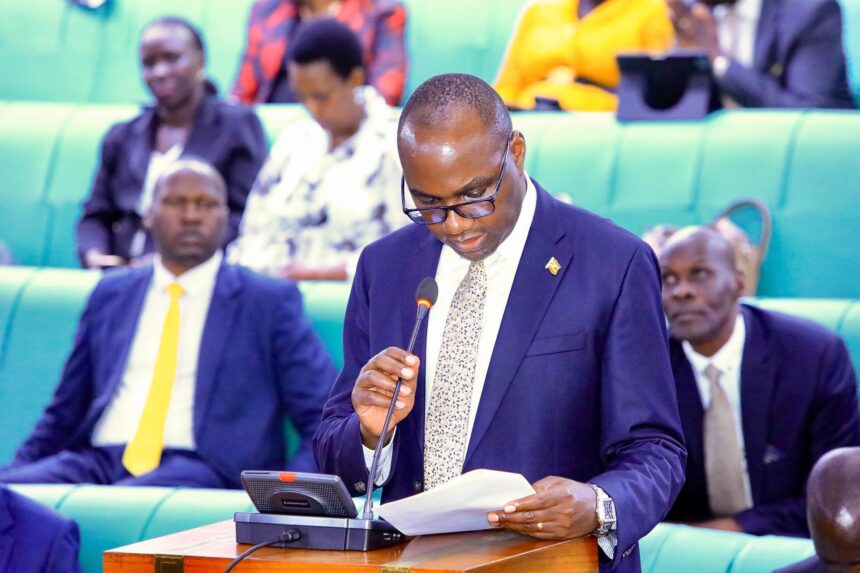

Government plans to inject Shs152 billion in working capital into tea factories and establish a Shs46 billion fertiliser revolving fund to revive the struggling tea sector, improve yields and enhance the quality of green leaf.
The Minister of Finance, Planning and Economic Development, Henry Musasizi, said the proposed interventions are aimed at addressing financial challenges facing tea factories and improving productivity among farmers.
During the plenary sitting on Tuesday, November 17, 2026, Minister Musasizi told Parliament that the proposed working capital support would be guided by an independent assessment of outstanding liabilities incurred by tea factories.
“Uganda Revenue Authority undertook a verification of tax liability and found that tea factories had outstanding domestic tax liabilities amounting to Shs39.329 billion. My ministry has since requested the URA Commissioner General to review the circumstances surrounding these liabilities,” Musasizi said.
He also revealed that government had provided Shs80 billion to the Ministry of Agriculture, Animal Industry and Fisheries in the 2025/2026 financial year under a broader fertiliser subsidy programme.

The funding, he said, would support the procurement of fertiliser from Intracom, which sources its supplies from manufacturing plants in Tanzania and Burundi, as well as Dei BioPharma Ltd through its Magoola Fertiliser Production Initiative.

Each of the two suppliers is expected to receive Shs40 billion under the arrangement.
The commitments follow concerns raised by Cohen Amanya (NRM, Igara County West) over the declining performance of the tea sector, which has been affected by low prices offered for green leaf.

Musasizi attributed the decline in the quality and competitiveness of Uganda’s tea to deteriorating soil fertility and limited fertiliser application, which have resulted in poor-quality green leaf fetching lower prices than that produced by regional competitors.
He further disclosed that government had paid Shs89.26 billion to verified nursery bed operators for supplying tea seedlings, leaving an outstanding balance of Shs18.9 billion owed to Buhweju Nursery Bed Operators.
The minister said the outstanding payment would be addressed in the 2027/2028 financial year and the medium-term expenditure framework.
Amanya urged government to consider tax relief for tea factories to enable them to clear their liabilities and resume full operations.
“The tea sector has the potential to bring a lot of money into the economy. I beseech the minister that in the ongoing assessments, they look into tax waivers that can be brought before Parliament for consideration and approval,” he said.
He also asked the Ministry of Agriculture to use accurate data when distributing fertilisers to ensure that farmers who need the inputs receive adequate supplies.
Richard Senteza (Independent, Lugazi Municipality) called for the proposed incentives to benefit all tea-growing areas across the country.
“In Lugazi, we have Moniko Tea Estate, Uganda Tea Corporation, Namayiba Tea Estate and Lugalambo Tea Estate, among others. It is my humble appeal that the proposed incentives should cut across to include the entire tea industry in Uganda,” Senteza said.
Kabarole District Woman Representative Annet Kirungi asked the Finance Minister to consider settling outstanding payments owed to tea seedling suppliers in her district.
Charles Ngabirano (Independent, Rwampara East County) also called for consideration of farmers and seedling suppliers in the Mbarara tea-growing belt.
Musasizi assured Parliament that the outstanding payments would be considered as part of ongoing discussions aimed at reviving the tea industry.