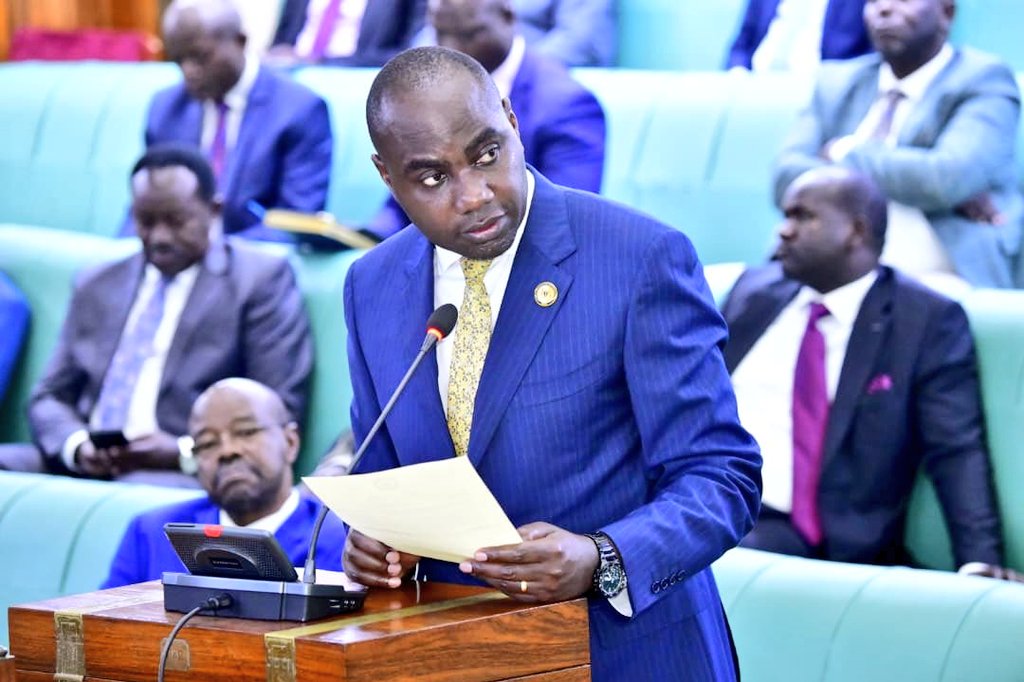

The Minister of State for General Duties, Henry Musasizi, on Tuesday tabled the National Budget Framework Paper (NBFP) for FY 2026/27–FY 2030/31 before Parliament, setting out Government’s strategic priorities aimed at accelerating Uganda’s economic transformation and inclusive growth.
The NBFP for FY 2026/27 is themed “Full Monetisation of Uganda’s Economy through Commercial Agriculture, Industrialization, Expanding and Broadening Social Services, Digital Transformation and Market Access.” The theme underscores Government’s commitment to boosting household incomes, creating jobs and strengthening Uganda’s competitiveness in regional and global markets.
The Framework Paper is fully aligned with the Fourth National Development Plan (NDP IV) covering FY 2025/26–FY 2029/30, the Charter for Fiscal Responsibility, and meets the requirements of gender and equity responsiveness as well as balanced regional development. FY 2026/27 will mark the second year of implementing NDP IV and the Tenfold Growth Strategy, which seeks to rapidly scale up economic output and productivity.
Looking ahead, Government’s strategic policy direction for FY 2026/27 and the medium term will focus on sustained investment in priority growth sectors and key enablers of the Tenfold Growth Strategy. Expenditure will be prioritised toward interventions with high economic and employment impact, promotion of export growth and diversification, expansion of regional trade and market access, improvement in the quality and stock of infrastructure, and strengthening domestic revenue mobilisation and public investment efficiency.
Government will also continue to pursue well-coordinated fiscal and monetary policies to support high and sustainable growth, implement measures to mitigate economic shocks, including climate-related risks, and enhance the efficiency and effectiveness of public institutions while strengthening anti-corruption efforts.

The economic outlook remains positive, with Uganda’s economy projected to grow by 10.4 percent by the end of FY 2026/27, up from an estimated 6.6 percent in FY 2025/26. This strong performance is expected to be driven largely by the commencement of oil production, which will generate new revenues and stimulate productivity across multiple sectors of the economy.

In nominal terms, Gross Domestic Product (GDP) is projected to rise from Shs 251.450 trillion in FY 2025/26 to Shs 290.315 trillion in FY 2026/27. Domestic revenue collections are also expected to increase to Shs 40.090 trillion, up from Shs 37.227 trillion in the previous financial year.
The preliminary resource envelope for FY 2026/27 is estimated at Shs 69.399 trillion, a reduction of Shs 2.977 trillion from the current FY 2025/26 budget. The budget will be financed through a mix of domestic and external resources, with a notable reduction in budget support and domestic borrowing, signaling efforts to strengthen fiscal sustainability.
Overall, the NBFP presents an optimistic and forward-looking roadmap, positioning Uganda for accelerated growth, job creation and structural transformation as the country advances toward full monetisation of its economy.