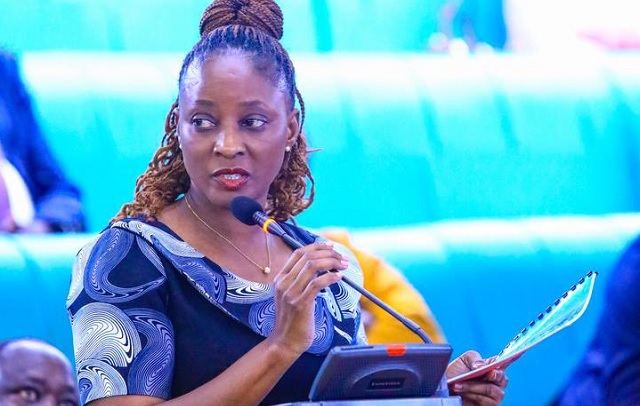

The death of Kalangala District Woman MP-elect Hellen Nakimuli has exposed a critical legal and administrative gap in Uganda’s electoral framework, raising urgent questions about how the country manages representation during political transitions.
Nearly Eleven days after her passing on April 19, 2026, the Clerk to Parliament, Adolf Mwesige Kasaija, had yet to formally notify the Electoral Commission (EC) of the vacancy—an apparent deviation from constitutional requirements and a contrast to how a similar case in Kikuube District was handled.
Nakimuli, 40, had just secured re-election on the ticket of the National Unity Platform (NUP) when she died in Kampala following complications from surgery. Her death came just weeks before the swearing-in of the 12th Parliament, scheduled for mid-May 2026.
In Kikuube District, following the death of LCV Chairperson Peter Banura on April 4, the Chief Administrative Officer promptly notified the EC in line with the Local Governments Act (Cap 243). Within two weeks, the Commission—headed by Justice Simon Byabakama Mugenyi—had rolled out a by-election roadmap, including stakeholder consultations and a June 10 polling date.
By contrast, the Kalangala parliamentary seat remains procedurally stalled, with no formal notification issued under Article 81 of the Constitution, which requires the Clerk to inform the EC within ten days of a vacancy and mandates a by-election within 60 days of such notification.

The divergence highlights not only administrative delay but also a deeper structural inconsistency in how Uganda manages local government and parliamentary vacancies.

At the centre of the impasse is the constitutional “six-month rule,” which bars by-elections within six months of a general election. With the 11th Parliament’s term expiring on May 12, 2026, the EC is effectively constrained from organising a by-election before the new Parliament is sworn in.
EC Chairperson Justice Simon Byabakama has described the situation as “unfortunate and peculiar,” noting that no by-election can be conducted within the remaining days of the current term.
“The practical vacancy begins when the new Parliament is sworn in,” he explained, meaning Kalangala will start the 12th Parliament without representation.
Only after the new Parliament is constituted—and the seat formally declared vacant—can the constitutional 60-day timeline for a by-election realistically begin, subject to notification by the Clerk.
Unlike local governments, where continuity is ensured through acting officials, parliamentary vacancies offer no such provision. Under the Local Governments Act, a Vice Chairperson automatically assumes office in an acting capacity upon the death of a district chairperson. No equivalent mechanism exists in Parliament.
This leaves Kalangala, an island district on Lake Victoria with unique socio-economic challenges, without direct representation at a critical moment of national transition.
“This is a classic legislative blind spot,” said Dan Musoke, a concerned voter. “Article 81 anticipates vacancies within a functioning Parliament. But the death of an MP-elect before swearing-in creates a legal grey area. The law does not clearly define when the vacancy arises or when notification should occur.”
The delay also raises questions about Parliament’s constitutional oversight role under Article 79, which mandates it to make laws for peace, order and good governance, and to ensure their effective implementation.
In this instance, Parliament is both subject and actor. The Clerk’s inaction—or caution—has direct implications for electoral timelines, even as legislators have previously criticised delays and inconsistencies in public administration.
Efforts to obtain a comment from Chris Obore, the Director of Communications and Public Affairs at Parliament, were unsuccessful by press time.
Even as legal questions persist, political dynamics are beginning to take shape. The NUP, through Secretary General David Lewis Rubongoya, has indicated it will wait for the EC roadmap before selecting a replacement candidate, observing a period of mourning.
Meanwhile, Nakimuli’s family has reportedly fronted her elder sister as a potential successor, both politically and in managing the Nakimuli Development Foundation—setting the stage for a potentially competitive by-election once timelines are clarified.
Her closest challenger in the January polls, Aidah Nabayiga of the ruling party, is also expected to re-enter the race.
Beyond legal interpretation, the case underscores the financial implications of Uganda’s by-election cycle. Electoral analysts estimate that a single parliamentary by-election can cost hundreds of millions of shillings in logistics, security and administration. While the six-month rule was partly designed to mitigate such costs, cases like Kalangala reveal how it can inadvertently create representation gaps.
Governance expert Tonny Opoka argues that the law assumes a predictable electoral cycle, yet real-world disruptions—such as deaths or court annulments—create complex edge cases.
“Uganda needs clearer transitional provisions and possibly digital tracking of vacancies to ensure timely action,” he said.
Uganda’s electoral history offers precedents. By-elections triggered by court nullifications or deaths—such as in Kawempe North and other constituencies—have often been marked by delays, disputes and logistical challenges.
These experiences point to a recurring issue: the gap between legal frameworks and operational readiness. The Kalangala case amplifies this concern at a particularly sensitive moment between two parliamentary terms, where institutional authority can be diffused and decision-making delayed.
For policymakers and researchers, Nakimuli’s death presents an opportunity to re-examine Uganda’s electoral laws.
Key reform questions include whether MPs-elect should be granted a defined legal status before swearing-in; when a vacancy should be deemed to occur during transitional periods; whether interim representation mechanisms can be introduced without undermining electoral legitimacy; and how Parliament can strengthen oversight of its own administrative processes.
The Public Finance Management Act (2015) already emphasises accountability and efficiency in public administration. Extending similar rigor to electoral management could help close existing gaps.
For the people of Kalangala, however, the issue is not merely procedural—it is deeply practical.
The district faces persistent development challenges, including limited infrastructure, service delivery constraints and vulnerability among fishing communities. The absence of a parliamentary representative, even temporarily, risks weakening its voice at the national level.
In a system where democratic legitimacy hinges on representation, even short-term vacancies carry weight. As Uganda prepares to inaugurate its 12th Parliament, the Kalangala case stands as an early test of institutional responsiveness.
Resolving the immediate impasse—through timely notification, clear guidance from the EC and an eventual by-election—will be critical. But the broader challenge lies in addressing the legal ambiguities that allowed the situation to arise in the first place.