



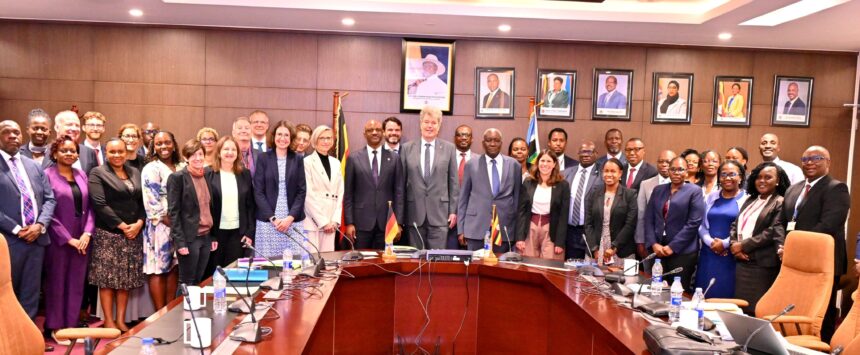

The Permanent Secretary and Secretary to the Treasury, Dr. Ramathan Ggoobi, has called on the international community to provide predictable and sustainable financing to support Uganda’s refugee response, warning that the growing responsibility of hosting millions of refugees requires stronger international solidarity and equitable burden-sharing.
Dr. Ggoobi made the call on Monday while opening the Uganda–Germany Government-to-Government Negotiations, where he also urged deeper economic cooperation aligned with Uganda’s Fourth National Development Plan (NDP IV) and the Tenfold Growth Strategy, which seeks to expand the country’s economy to US$500 billion by 2040.
He noted that Uganda was hosting approximately 2.05 million refugees and asylum-seekers as of September 2026, making it one of Africa’s leading refugee-hosting countries.
The growing refugee population has placed increasing pressure on the country’s humanitarian resources, particularly in refugee-hosting districts, where demand for essential services such as healthcare, education, clean water, sanitation, food and shelter continues to rise.
According to statistics published by the United Nations High Commissioner for Refugees (UNHCR) and Uganda’s Office of the Prime Minister, the country was hosting 2,050,820 refugees and asylum-seekers as of September 30, 2026. Of these, 1,965,952 were refugees, while 84,868 were asylum-seekers.

During the negotiations, Uganda and Germany reaffirmed their commitment to strengthening a mutually beneficial and results-oriented partnership based on mutual respect, shared priorities and sustainable development, building on more than six decades of bilateral cooperation.

Dr. Ggoobi emphasized the need for increased German investment, technology transfer, industrialisation, skills development and enterprise growth, particularly in Uganda’s four priority sectors under the ATMS framework: Agro-Industrialisation, Tourism Development, Mineral Development, and Science, Technology and Innovation, alongside their critical enablers.
He stressed the importance of translating bilateral cooperation into increased production, value addition, exports, employment opportunities and improved livelihoods for Ugandans.
The Head of the German Delegation, Mr. Joachim Schmitt, who also serves as Head of the Central and East Africa Division at Germany’s Federal Ministry for Economic Cooperation and Development, reaffirmed Germany’s commitment to strengthening bilateral cooperation through mutual accountability, measurable development outcomes and increased private-sector participation.
Schmitt commended Uganda’s progressive refugee-hosting policy and its contribution to regional stability, while acknowledging the growing humanitarian pressures associated with hosting a large refugee population.
He also highlighted Germany’s continued engagement in supporting climate resilience, regional health security and sustainable development, including the construction of six valley tanks in the Karamoja sub-region.
Schmitt further emphasized that good governance, transparency, accountability, respect for human rights and a predictable investment environment remain critical foundations for sustainable cooperation.
He called for stronger trade, technology and private-sector partnerships, noting that mobilising private capital alongside development financing would be essential in accelerating Uganda’s economic transformation.