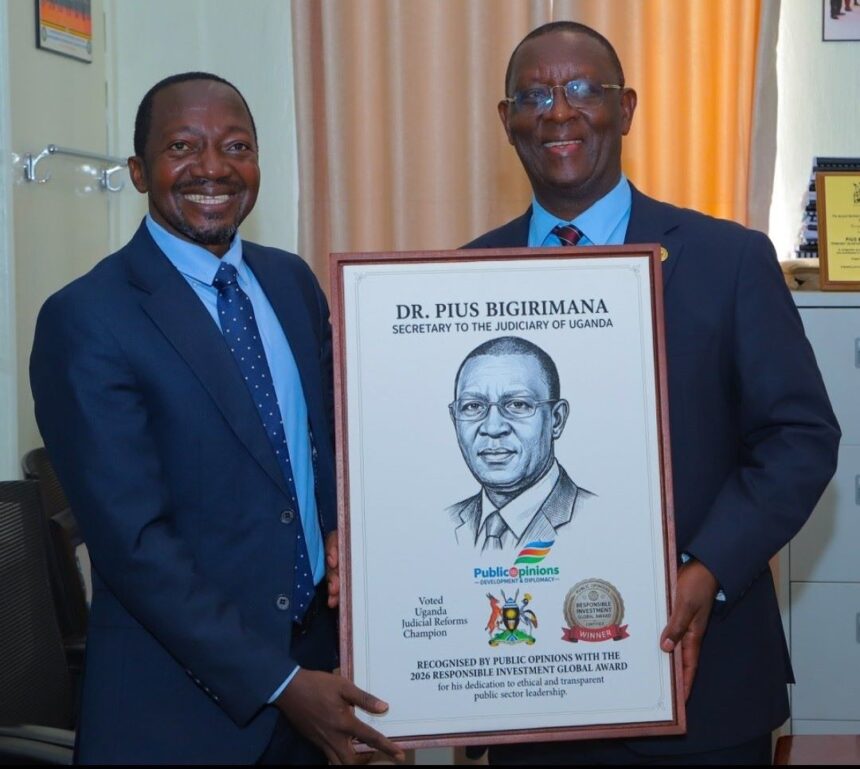

A leading field-based research organization, Public Opinion, has recently recognized the Judiciary of Uganda, one of the critical arms of government, for its contribution to sustainable development and ongoing judicial reforms.
Among the key reforms for which the Judiciary was recognized are the Alternative Dispute Resolution (ADR) mechanism and the Electronic Court Case Management Information System (ECCMIS), both of which have significantly transformed and improved the administration of justice in Uganda.
According to Judiciary Permanent Secretary, Dr. Pius Bigirimana, ADR, championed by the President of Uganda, General Yoweri Kaguta Museveni, and strongly promoted by former Chief Justice Justice Alfonse Owiny-Dollo, is expected to substantially reduce case backlog.
He describes ADR as “Africa’s original justice system,” rooted in mediation, reconciliation, plea bargaining, and restoring harmony among communities.
Dr. Bigirimana noted that, as the Accounting Officer of the Judiciary, he remains committed to supporting ADR efforts by ensuring that all newly constructed courts include mediation rooms.

He also emphasized plans to allocate funding toward the training and accreditation of mediators already deployed in various courts across the country. Importantly, he highlighted that ADR services are offered free of charge, with mediators facilitated by the Judiciary.

Regarding the Electronic Court Case Management Information System (ECCMIS), Dr. Bigirimana is credited for playing a key role in its implementation after concluding and signing the contract that led to its rollout. The automated system, which tracks the entire history of court cases, has streamlined court processes by reducing physical interactions, a move seen as instrumental in minimizing corruption.
Since its commissioning in October 2021, ECCMIS has reportedly increased the case filing rate by 20.6 percent, while the average case completion rate has grown by 17.5 percent. This has enhanced efficiency in case management and strengthened Uganda’s investment climate by improving access to justice—an essential factor for economic growth and job creation.
An efficient judicial system plays a critical role in attracting foreign direct investment and creating a conducive business environment. Globally, hundreds of billions of dollars remain tied up in arbitration and commercial disputes. In Uganda, the Chief Justice recently revealed that approximately UGX 7 trillion remains locked in commercial court cases, limiting capital circulation for production and employment opportunities.
Beyond ADR and ECCMIS, the Judiciary has undertaken several other reforms aimed at improving service delivery. These include strengthened anti-corruption measures through the Inspectorate of Courts, the introduction of toll-free reporting lines, and the installation of surveillance cameras in courts.
Additionally, significant investments have been made in court infrastructure, including the construction of the twin towers for the Supreme Court and Court of Appeal, as well as regional court buildings. Magistrate jurisdictions have reportedly increased from 82 to 157, enabling every district to have judicial leadership and bringing justice services closer to citizens.
Other reforms introduced to improve case management and service efficiency include the Small Claims Procedure, special court sessions, and other justice enhancement initiatives.
As Uganda advances toward Vision 2040 and its ambition of achieving a $500 billion GDP economy within 15 years, the Judiciary is expected to play a central role in promoting the rule of law, enhancing investor confidence, and supporting national socio-economic transformation.
The writer, Ben Ssebuguzi, is a Researcher in the Office of the National Chairman, NRM.