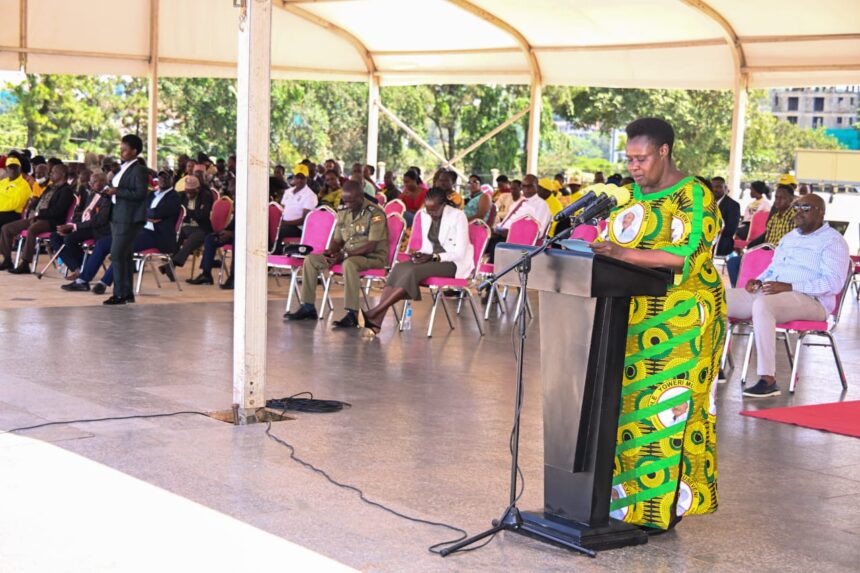

Vice President Jessica Alupo has called on children of armed forces personnel to actively embrace government wealth creation initiatives, including the Parish Development Model (PDM), Emyooga, the Youth Livelihood Fund, and Presidential Skilling Hubs, as a pathway to prosperity.
Alupo emphasized that engaging every household in income-generating activities is key to achieving the National Resistance Movement (NRM) government’s goal of socio-economic transformation.
She made the remarks while representing President Yoweri Museveni at a thanksgiving ceremony organized by children of personnel from the Uganda Prisons Service, Uganda Police Force, and the Uganda People’s Defence Forces. The event, held at Kololo, celebrated the NRM’s victory in the January general elections.
The ceremony marked a historic milestone, bringing together—for the first time—children of fallen heroes, veterans, and serving armed forces members on a national platform to give thanks, affirm loyalty, and express their commitment to national service.
Alupo thanked God for what she described as peaceful campaigns and elections that resulted in a decisive NRM victory nationwide. She noted that Uganda’s continued stability is rooted in democratic principles that allow citizens to freely choose their leaders.
“The people determine who governs them, from the local to national levels. This is why Uganda has remained stable and strong,” she said.

She highlighted that peace and stability have led to increased agricultural and industrial production, pointing to surplus production of commodities such as maize, sugar, milk, bananas, and eggs across the country. However, she acknowledged that about 33% of households remain outside the money economy.

Alupo urged such households to tap into existing government programs, noting that resources are available and can be scaled up through initiatives like PDM, Emyooga, and other targeted funds.
She further pointed to improvements in infrastructure, including roads, electricity, and ICT, as key drivers of investment and economic growth, reducing the cost of doing business.
“Development alone is not enough. It must translate into jobs and wealth at the household level to be meaningful,” she added.
Winnie Lokech, President of the United Children of the Armed Forces Network (UCAFNET), said the gathering reflected a generation shaped by sacrifice, discipline, and patriotism, now ready to contribute meaningfully to Uganda’s future.
“It marks a transition from remembrance to responsibility, and from inheriting sacrifice to safeguarding peace,” she said.
Lokech noted that UCAFNET represents over 130,000 children of fallen heroes, veterans, and serving personnel. She outlined several proposals to support their welfare, including prioritizing them in industrial hubs and skilling programs, establishing a Presidential Scholarship and Education Endowment Fund, strengthening UCAFNET SACCOs, and creating a dedicated directorate within the Ministry of Defence and Veteran Affairs.
She also called for structured pathways into national service and greater inclusion of children of armed forces in civic leadership and democratic processes.
“We believe peace should not only be defended by arms, but also through informed leadership and active participation in governance,” Lokech said.