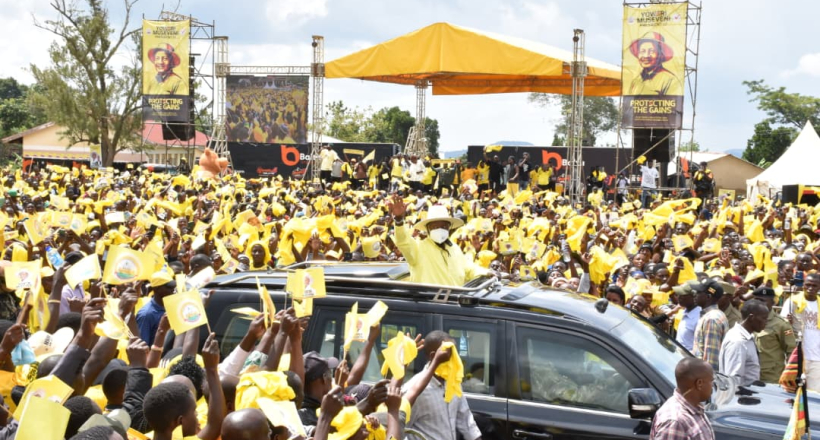

President Yoweri Museveni’s campaign rally in Gomba District on Tuesday brought to the fore key governance and development issues as the ruling National Resistance Movement (NRM) seeks to consolidate support ahead of the elections.
Addressing residents and senior party leaders, Museveni framed peace and stability as the NRM’s foundational achievement, arguing that Uganda’s relative calm stands out in a region affected by recurring conflict. He said maintaining security remains central to the country’s social and economic progress.
Beyond security, President Museveni turned to development, raising concern that some elected leaders fail to fully support or implement government programmes.
He linked this gap to slow service delivery and uneven impact of public investments at community level.
Museveni announced plans to rehabilitate and upgrade several roads in the region, including the Kifampa–Bugomora–Kyamulibwa–Villa Maria road and the Kanoni–Maanyi–Mityana–Ssekanyonyi–Busunju road. He also pledged to extend electricity to sub-counties that are still off the national grid, highlighting infrastructure as a driver of growth.

However, he cautioned that infrastructure alone cannot eliminate poverty without deliberate household-level wealth creation. Revisiting the four-acre agricultural model introduced in the 1990s, Museveni encouraged families to adopt integrated farming, combining cash crops, food production and livestock, arguing that productivity at household level is key to fighting poverty. He also promoted zero-grazing as a more efficient farming approach.

The President further emphasized the Parish Development Model (PDM), noting that each parish receives Shs100 million annually to support grassroots economic activities.
He warned against mismanagement of the funds and said government would pursue individuals involved in theft or abuse of public resources.
Museveni reiterated that all Ugandan’s aged 18 and above are eligible to join parish SACCOs and benefit from the programme.
NRM Vice Chairperson Alhaji Moses Kigongo warned supporters against backing so-called “NRM-leaning” candidates, insisting that divided loyalty weakens the Movement and undermines its agenda.
He urged voters to support President Museveni and all official NRM flag bearers.
Speaker of Parliament and NRM Second National Vice Chairperson (Female), Anita Annet Among, described the turnout in Gomba—an area often associated with opposition politics—as a sign of shifting political dynamics. She called on party supporters to end internal wrangles, saying infighting affects service delivery and development.
Among also presented community demands to the President, including the completion of key road projects such as Masaka–Villa Maria, Villa Maria–Kalungu–Kabulasoke, and Maddu–Kabamba. She reminded Museveni of a pledge to establish a regional referral hospital for the cattle corridor and said residents were requesting an irrigation scheme and a piped water system.
She further noted that following the closure of Kabulasoke Primary Teachers’ College, residents were promised a university, which is yet to be realized.
Earlier, NRM Vice Chairperson for Buganda Region Haruna Kasolo raised concerns over land issues in Gomba, particularly disputes involving forest land.
He commended government for its decision to return some forest land to local communities and urged continued attention to land governance.
Overall, the Gomba rally highlighted key policy debates around peace and security, infrastructure development, wealth creation, accountability in public programmes, land management and internal party cohesion, issues that are likely to shape the political conversation as the country heads toward the polls.