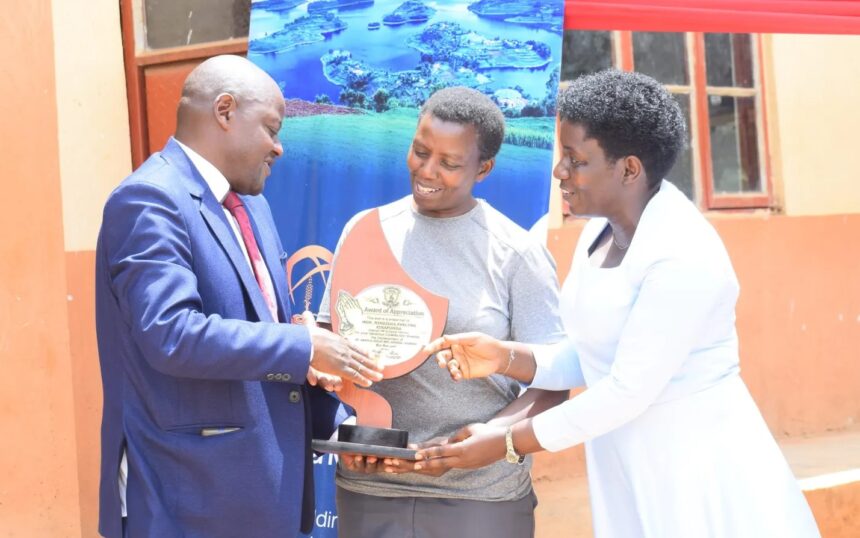

Leaders and educationists have raised concern over the widening digital divide in rural schools, saying limited access to technology continues to disadvantage learners and deepen education inequality, as Rubanda District commissioned a new ICT e-learning hub at St. Agatha Girls’ Secondary School Kakore.
The concern was raised during the commissioning of the modern facility established by the International Community of Banyakigezi (ICOB Apex), with stakeholders describing the project as a direct response to persistent challenges facing rural schools in accessing digital learning tools.
The hub was officially opened on Saturday, April 25, 2026, by Rubanda District Woman Member of Parliament elect Ninsiima Evelyne Kikafunda, who represented State Minister for Finance (General Duties) and Rubanda East MP Henry Musasizi.
Education leaders noted that while Uganda’s competence-based curriculum increasingly demands digital literacy, many rural schools remain constrained by inadequate ICT infrastructure, leaving learners unable to effectively conduct research, access online learning materials, or develop practical computer skills.
Rubanda District Education Officer Francis Serununu said the lack of digital resources has for years limited effective implementation of modern teaching approaches in many schools.

He noted that although the establishment of the ICT hub is a major milestone, similar interventions are urgently needed across the district if education standards are to improve.

“Our learners are expected to compete nationally under a curriculum that heavily integrates ICT, yet many schools still lack basic computer facilities. This creates an uneven learning environment,” Serununu said.
Parents and community leaders echoed similar concerns, describing digital exclusion as one of the biggest barriers to quality education for rural learners.
PTA Chairperson Wensi Ruyooka said students in rural schools have long struggled to match the performance of learners in urban institutions due to limited access to technology.
“This facility addresses a gap that has existed for years. Without access to computers and internet resources, our children have been competing at a disadvantage,” he said.
Teachers at St. Agatha Girls’ Secondary School said the shortage of computers had previously affected practical lessons and slowed down effective delivery of the competence-based curriculum.
ICT teacher Alexander Orikunda said limited access to digital equipment had often caused congestion during practical sessions and restricted students’ exposure to essential technological skills.
Students also pointed out that many modern textbooks now direct learners to online resources for further study, yet access to such materials has remained difficult for schools without functional ICT infrastructure.
Rev. Fr. Deusdedit Maniragaba, Parish Priest of Kakore Parish, said the increasing influence of digital technology and artificial intelligence in education makes it imperative for rural schools to adapt or risk being left behind.
He called for deliberate investment in technology to ensure learners from remote areas are not excluded from opportunities available in the digital age.
Rubanda District Secretary for Health and Education Obed Mutatina Kitabutuka praised ICOB Apex for responding to the challenge, saying diaspora-led initiatives are becoming critical in addressing education infrastructure gaps.
He urged other development partners and government agencies to prioritize ICT investment, particularly for schools educating girls.
Speaking during the commissioning, Honorable Kikafunda said the new facility reflects a growing recognition that digital skills are no longer optional but essential for academic and professional success.
She called on the school administration, teachers, and students to ensure proper management of the facility so that it remains functional for future generations.
The ICT e-learning hub, supported by ICOB Apex and complemented by computer donations from Bank of Uganda, is expected to improve access to digital learning resources and serve as a model for addressing technology disparities in rural schools across Rubanda and the wider Kigezi region.