

Summary:
- In a statement issued from Arusha, Tanzania on Tuesday, EALS President Ramadhan Abubakar emphasized that the decision casts doubt on the commitment of EAC partner states to fully implement the Common Market Protocol, which guarantees the free movement of people, goods, services, and capital within the community.
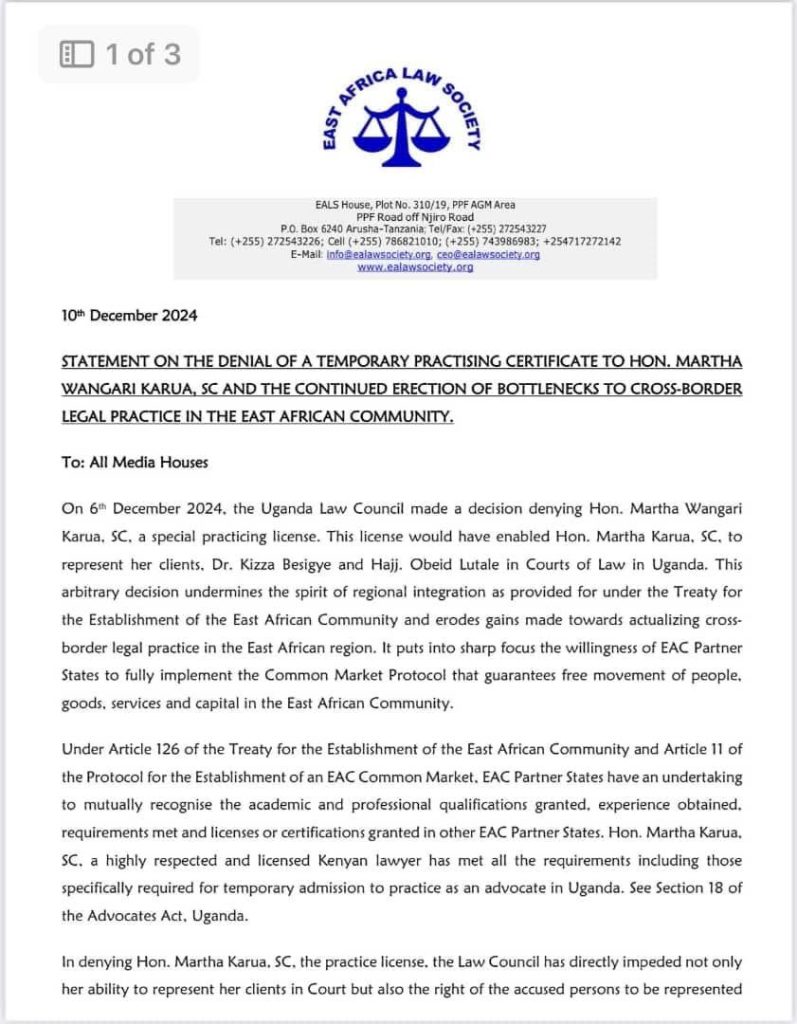
ARUSHA: The East Africa Law Society (EALS) has criticized the decision by the Uganda Law Council to deny Kenyan Senior Counsel Martha Wangari Karua a special practicing license to represent her clients, Dr. Kizza Besigye and Hajj Obeid Lutale, in Ugandan courts.
The society argues that the move undermines the spirit of regional integration enshrined in the Treaty for the Establishment of the East African Community (EAC) and erodes progress towards cross-border legal practice in the region.
In a statement issued from Arusha, Tanzania on Tuesday, EALS President Ramadhan Abubakar emphasized that the decision casts doubt on the commitment of EAC partner states to fully implement the Common Market Protocol, which guarantees the free movement of people, goods, services, and capital within the community.

“Under Article 126 of the Treaty for the Establishment of the East African Community and Article 11 of the Protocol for the Establishment of an EAC Common Market, partner states are obligated to mutually recognize academic and professional qualifications, experience, and licenses granted in other EAC countries,” Abubakar stated.

He highlighted that Senior Counsel Karua, a respected and licensed Kenyan lawyer, had met all the requirements, including those specific to temporary admission as an advocate in Uganda.
Abubakar criticized the Uganda Law Council’s decision, saying it not only obstructed Karua’s ability to represent her clients but also infringed on the right of the accused to legal representation of their choice, as guaranteed under Article 7(1)(c) of the African Charter on Human and Peoples’ Rights.
“This denial of a fundamental component of a fair trial, recognized in both regional and international legal instruments, sets a dangerous precedent that could undermine the independence of judicial bodies and tribunals in East Africa,” he warned.
Abubakar further argued that the decision erodes public confidence in institutions designed to serve citizens and disregards internationally recognized standards for cross-border litigation.
He cited standards such as the Commonwealth guidelines, the International Bar Association Standards on the Independence of the Legal Profession (Article 19), and the UN Basic Principles on the Role of Lawyers.
As the regional body representing advocates across the EAC, EALS condemned the decision and urged the Uganda Law Council to reconsider.
Abubakar also called on EAC leadership and partner states to expedite the signing and implementation of the Mutual Recognition Agreement (MRA) for lawyers, a framework designed to ensure mutual recognition of professional qualifications.
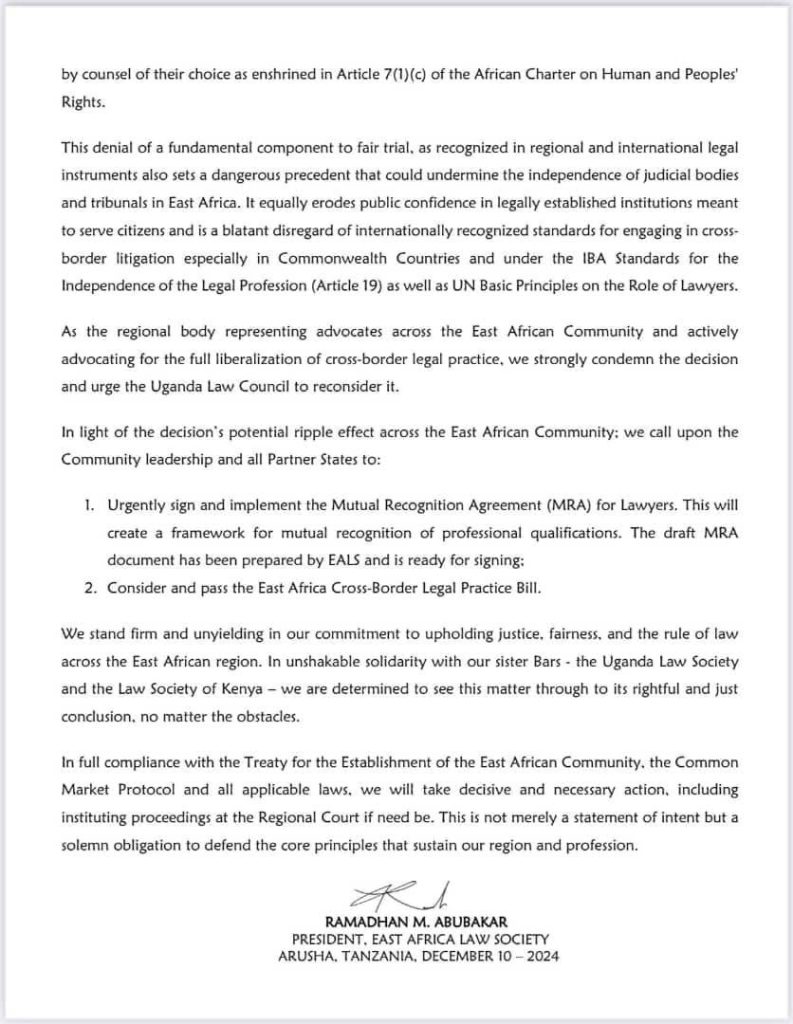
He noted that the draft MRA prepared by EALS is ready for signing and urged lawmakers to pass the East Africa Cross-Border Legal Practice Bill.
“We remain unwavering in our commitment to uphold justice, fairness, and the rule of law across East Africa. In solidarity with the Uganda Law Society and the Law Society of Kenya, we are determined to pursue this matter to its rightful conclusion,” he declared.
Abubakar also hinted at potential legal action, stating that EALS would not hesitate to institute proceedings at the East African Court of Justice if necessary, in full compliance with EAC laws and protocols.