
Parliament of Uganda has passed the Protection of Sovereignty Act, 2026, concluding nearly a month of public debate, political tension, and scrutiny over its implications for governance, civil liberties, and Uganda’s economic environment.
The law, approved during the May 5 plenary sitting chaired by Anita Among, introduces sweeping restrictions on individuals and entities classified as “agents of foreign principals,” while imposing stringent disclosure and compliance requirements.
At 8:37 pm, the Speaker put the question to the House, with the majority of the 353 legislators voting in favour of the Bill.
Under the new law, supervised institutions are barred from processing payments to an agent of a foreign principal unless the recipient declares the source of funds and provides proof of such declaration. Violations attract penalties of up to UGX 2 billion for companies and UGX 1 billion for individuals, alongside possible imprisonment of up to 10 years.
The Act also criminalises foreign interference in Uganda’s electoral processes, prohibits promotion of foreign policy positions not adopted by Cabinet, introduces offences related to “economic sabotage,” including publishing false information deemed harmful to the economy, requires registration and regulation of foreign agents under tighter state oversight.

The vote followed an unusual and heavy security deployment around Parliament, with roads blocked and armed personnel stationed at key access points.

Leader of the Opposition Joel Ssenyonyi criticised the move, describing it as a sign of “fear and guilt” by the ruling establishment.
“The heavy deployment signifies fear and guilt. They know what they are doing is not right,” Ssenyonyi said.
Kira Municipality MP Ibrahim Ssemujju Nganda also raised safety concerns, likening Parliament’s surroundings to a “barracks” and seeking assurances from the Chair.
Speaker Among downplayed the concerns, insisting legislators were safe within the chamber.
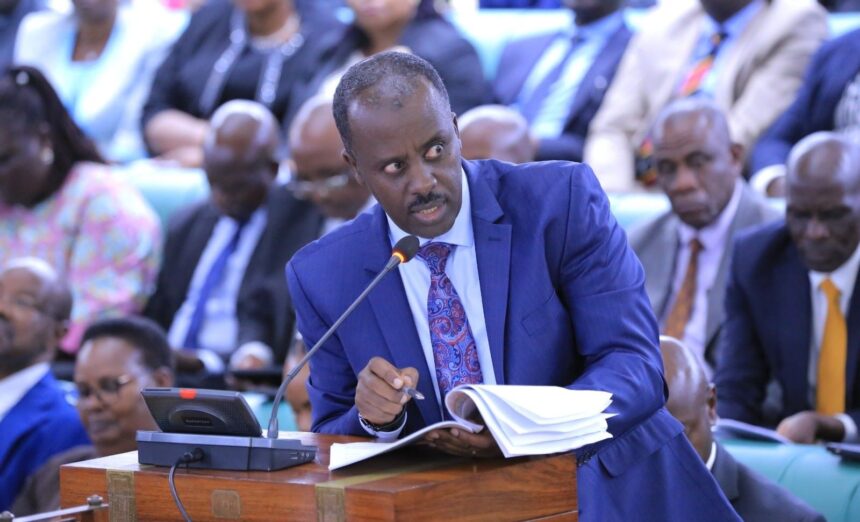
Presenting the joint committee report, Defence and Internal Affairs Committee Chairperson Wilson Kajwengye acknowledged widespread stakeholder concerns.
“The Bill’s objective is overly broad… its regulatory approach duplicates existing frameworks, and excess power is concentrated in the Minister,” Kajwengye noted.
Despite these reservations, Parliament proceeded to pass the Bill with amendments. The legislation exposed deep divisions within Parliament.
Of the 56 committee members, 24 declined to sign the main report, prompting minority reports led by Jonathan Odur (Erute County South), Betty Nambooze (Mukono Municipality) and Medard Lubega Sseggona (Busiro County East).
The dissenting legislators called for withdrawal of the Bill, arguing that last-minute amendments by the Attorney General fundamentally altered its intent.
Odur criticised the process, citing a rare публич rift in which presidential directives reportedly contradicted earlier legal instructions.
Parliament adopted amendments that reduced penalties from earlier proposals which includes corporate fines cut from UGX 4 billion to UGX 2 billion, individual fines reduced from UGX 2 billion to UGX 1 billion, and maximum jail terms halved from 20 to 10 years.
Legal Affairs Committee Chairperson Stephen Baka defended the revisions, saying they ensure proportionality and introduce the requirement to prove criminal intent.
Minister of State for Internal Affairs David Muhoozi described the outcome as a “reasonable middle ground.”
Lawmakers criticised the Ministry of Finance’s estimate that implementation would cost UGX 29.029 billion, arguing it failed to account for broader economic risks.
MPs warned the law could constrain liquidity, reduce capital inflows, affect correspondent banking relationships, disrupt remittances and credit growth.
Parliament removed several controversial provisions, including mandatory mental and physical health checks for foreign agents, citing inconsistency with the Mental Health Act, public access to funding disclosure records, due to concerns over privacy and data protection laws.
The enactment of the law marks a significant shift in Uganda’s regulatory landscape, particularly in how foreign funding, civic engagement, and political activity are governed.
While government maintains the law is necessary to safeguard national sovereignty, critics argue it risks shrinking civic space, undermining investor confidence, and duplicating existing legal frameworks.