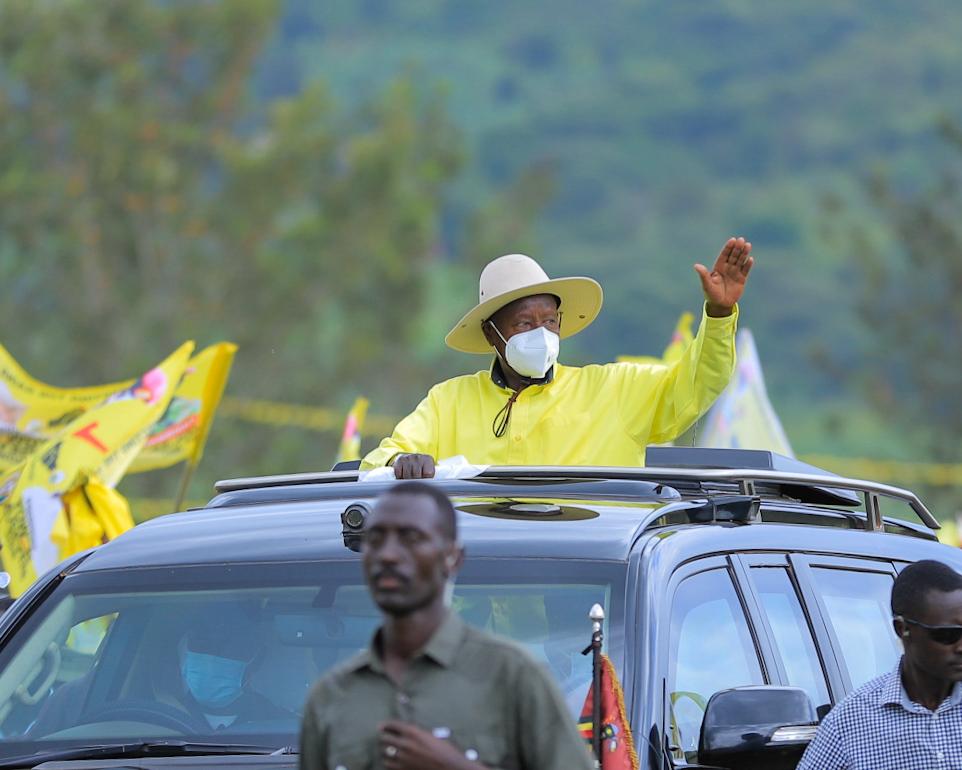

The Ruling National Resistance Movement (NRM) Presidential Candidate, Yoweri Kaguta Museveni, has warned parish chiefs and SACCO leaders against demanding land ownership as a condition for accessing Parish Development Model (PDM) funds, saying the programme is meant to lift the poor out of poverty, not to benefit the already wealthy.
Addressing thousands of supporters at Kyamate Primary School playgrounds in Ntungamo District on Thursday, Museveni, who is also the incumbent President of Uganda, clarified that PDM guidelines do not require beneficiaries to own land.
“What matters is a viable project,” he said, citing Kenneth Ayesiga from Nyamirama in Kanungu District, who had no land but successfully used PDM funds to rent premises and start the PDM Restaurant.
Museveni urged residents to report any district officials who solicit bribes during recruitment processes, stressing that jobs must be awarded on merit.
He rallied the people of Ntungamo to take advantage of ongoing government development programmes to create wealth at household level, saying government can only provide an enabling environment, but individuals must seize the opportunities.

“We have brought development to Ntungamo—roads, electricity, schools, hospitals, and water. But development alone does not make you wealthy,” Museveni said. “Wealth creation is your responsibility. Use the capital from government programs wisely and transform your households.”

He highlighted key socioeconomic empowerment initiatives, including the Parish Development Model, Emyooga, the Youth Livelihood Programme, and the Women Empowerment Fund, describing them as strategic tools for funding income-generating activities.
Museveni urged residents to distinguish between government-led development and personal wealth creation.
“Government works on development—roads, electricity, hospitals, and security. You must work on wealth creation. The two are different, and both are necessary,” he noted.
He also underscored the central role of free universal education in job creation, saying it equips young people with employable skills. He revealed that many graduates from the Presidential Industrial Skilling Hubs, particularly the one in the Ankole Sub-region, have become job and wealth creators.
“Universal education is not just about classrooms. It leads to skills, and these skills lead to jobs. The young people trained at our skilling hubs are now employing others. That is the true impact of free universal education,” he said, calling on the people of Ntungamo to defend and support the full implementation of the policy.
“Do not allow anyone to sabotage free education. It is a foundation for wealth creation, and it must be protected,” he added.
Museveni further elaborated the NRM government’s industrialization strategy as a cornerstone for creating sustainable employment opportunities. He pointed out growth sectors such as commercial agriculture, ICT and services as key engines for income generation.
“Industrialization is the future. Combined with commercial agriculture, ICT, and the services sector, we have a complete package for job creation,” he said.
The NRM Presidential Candidate also reaffirmed government plans to expand road infrastructure in Ntungamo, announcing new tarmac projects including the Mirama Hills–Kitwe–Rugorogota–Kitagata road, the Nyamuyanja–Kabuyanda road, and the Kitwe–Rukoni–Bugamba road.
“These roads are coming. They will ease transport, boost trade, and further open up Ntungamo for development,” Museveni assured residents, adding that more projects in infrastructure, health, education and economic empowerment are planned for the district.
He reminded voters that Ntungamo’s current development has been realized because of the peace and stability ushered in by the NRM government.
“Peace is the foundation of all development. Guard it jealously. Without peace, none of these achievements would exist,” he said.
Earlier in the day, while addressing a large crowd at Isingiro District Headquarters, Museveni reflected on Uganda’s journey from conflict to stability. He thanked God for the peace the country enjoys, recalling the years when he passed through the area armed during the liberation struggles of 1972, 1979 and 1985.
“Today we have gathered peacefully, well-dressed, dancing and united,” he said. “I thank God, and I thank the NRM for restoring peace in Uganda.”
He cited the NRM’s achievements in peace-building and infrastructure development, pointing to completed roads such as the Mbarara–Kikagate–Isingiro road and the Kachumbala–Kabale–Ntungamo road. He also reaffirmed government commitment to upgrading priority routes, including the Kikagate–Kitwe–Namahimba road and the Kabingo–Rwekubo–Rugaaga–Endizi–Magabi–Rakai–Mutukula road, which he said are vital for opening markets and easing farmers’ access.
Museveni shifted focus to Uganda’s next phase of economic transformation, insisting that while development is important, household wealth creation must now take centre stage. He said many people in urban centres like Kampala remain poor despite good infrastructure because they have not embraced income-generating activities.
He outlined four pillars of wealth creation: commercial agriculture, manufacturing and factories, services such as transport and hospitality, and ICT. He reminded residents that the Four-Acre Model, introduced in the 1996 NRM Manifesto, remains a practical pathway for smallholders to escape poverty—one acre for coffee, one for fruits, one for pasture for dairy cattle, and one for food crops, with backyard poultry or piggery and fish farming where applicable.
Museveni stressed that jobs are largely created in these wealth-creation sectors, not in government offices. He noted that Uganda has only about 480,000 government jobs for a population of 50 million people, making it impossible for everyone to be employed by the state.
He cited Mbale Industrial Park, which now hosts more than 75 factories that have created thousands of jobs, and said new factories across the country have generated about 1.3 million jobs—almost three times more than those in the public sector.
The President advised banana farmers in the predominantly banana-growing region to adopt irrigation and modern farming methods to boost yields and strengthen their competitiveness in national and regional markets.
Speaker of Parliament Rt. Hon. Anita Annet Among, who is also the NRM Second National Vice Chairperson, hailed Isingiro for its discipline, accountability and overwhelming support for the NRM. She revealed that leaders had launched a workers’ SACCO to boost household incomes and commended ongoing government water projects benefiting both host communities and refugees.
State Minister for Agriculture Hon. Lt. Col. Bright Rwamirama assured the President of continued massive support for the NRM, while NRM District Chairperson Lt. Moses Mushabe reminded Museveni that Isingiro delivered 94% of the vote in the 2021 general elections and pledged an even higher percentage in the next polls.
Mushabe highlighted the district’s rapid growth—30 sub-counties and town councils, 131 parishes, 901 villages and a population of 635,077—alongside rising demand for social services, especially health, due to the influx of refugees.
He reported that Isingiro has received Shs 47.1 billion under PDM, with 41,131 households already benefiting, and Shs 3.35 billion under Emyooga, supporting 89 SACCOs with 31,901 members.
The district’s education sector comprises 197 government primary schools, 543 private primary schools, 21 government secondary schools and 75 private secondary schools. Seven new Seed Secondary Schools are under construction to close gaps in underserved parishes.
Through the Presidential Industrial Skilling Hubs, 1,226 youth have been trained, with 247 currently undergoing training in various trades.
Isingiro’s health infrastructure includes 4 Health Centre IVs and 26 Health Centre IIIs, though 8 sub-counties still lack government health facilities. Government plans to upgrade existing units and construct new Health Centre IIIs in Kabingo and Kagarama.
Water coverage in the district stands at 51%, supported by major piped water systems, gravity-flow schemes, protected springs, borehole rehabilitation, and ongoing works such as the Isingiro Piped Water and Sanitation System.
Government has also invested heavily in water for production through large valley tanks, small-scale irrigation schemes, dam rehabilitation, and the flagship Kabuyanda Multipurpose Dam, expected to benefit 32,000 farmers across 38 villages.
The district is now fully connected to the national electricity grid, powering homes, businesses and public institutions, which leaders say lays a strong foundation for further industrial and agricultural growth.