



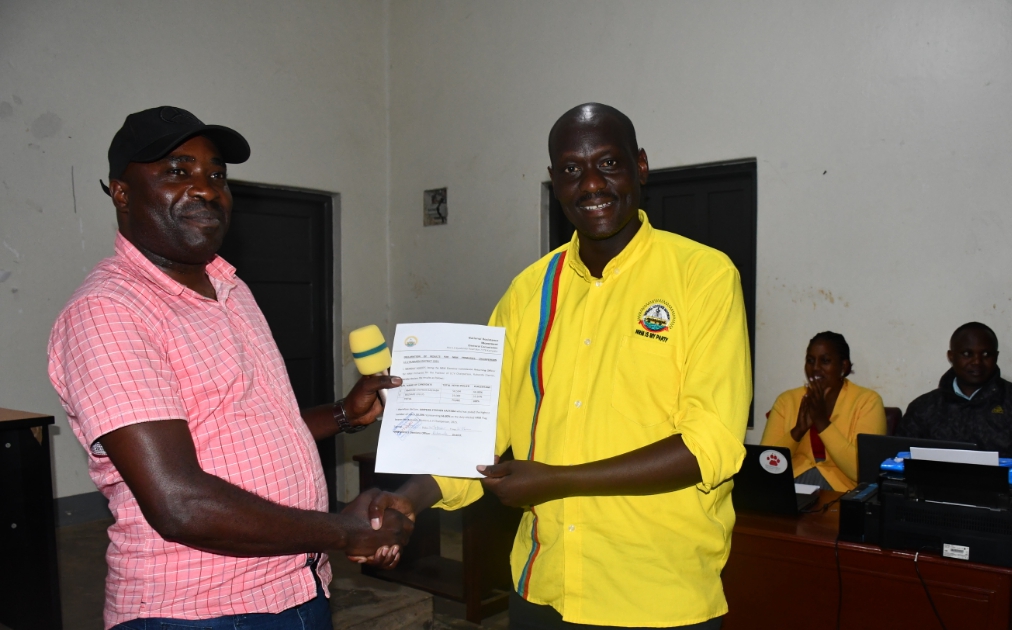

In Kigezi’s often turbulent local politics, the recent NRM primaries in Rubanda District delivered a message as loud as it was instructive. Stephen Kasyaba, the incumbent LC5 Chairperson, emerged with an overwhelming margin of victory, defeating Buzare Julius by 27,662 votes, a figure so commanding it leaves little room for ambiguity.
Yet, this was no ordinary political victory. Kasyaba was not only running against his fellow contender; he was also, in many ways, contending with a high-level coalition of political forces within the district.
From Woman MP Prossy Akampurira Begumisa Mbabazi ( Commissioner of Parliament) to former district chairperson Jogo Kenneth Biryabarema and Hon Kamuntu Moses Mwongyera Rubanda West County Member of Parliament, the effort to unseat Kasyaba became a carefully coordinated operation. But the people of Rubanda rejected it, decisively. Why?
The answer lies in the long-misunderstood chemistry between leadership and grassroots trust. In Rubanda, Stephen Kasyaba has not merely “held office”, he has lived among the people, worked with them, and delivered tangible results.
It is easy in Uganda’s political discourse to overuse phrases like “being on the ground” and “working with people,” but in Kasyaba’s case, these are not empty slogans. They are observable truths.

Take a walk across Rubanda, and you’ll find visible projects, roads opened, water systems extended, health centers renovated, new school school structures raised, youth initiatives initiated, not always grand in scale, but undeniably present and appreciated.

Unlike many of his rivals, Kasyaba has remained physically and emotionally anchored in the district, available to the people who elected him, and it is this consistency that voters rewarded.
That some senior political actors reportedly asked their agents to campaign against him only heightened the symbolic clarity of the results. The electorate wasn’t simply choosing a man; they were rebuking the idea that political influence could be traded behind closed doors and imposed on a rural population.
Kasyaba’s win is a blow to the condescending logic that believes voters are pawns in elite chess games. On the contrary, Rubanda voters sent a statement: they know who works, they know who shows up, and they know who doesn’t.
This election was not just a referendum on a man, it was a referendum on a mindset. The mindset that assumes influence at the center must automatically translate to control at the grassroots.
The mindset that views rural people as unable to evaluate performance without being told what to think. Rubanda rejected that mindset with a clarity that should force every serious political actor in Uganda to pause and reflect.
At the national level, this result carries important lessons. First, incumbency alone is no longer enough. Second, name recognition, especially without meaningful connection to community outcomes, is increasingly weak as a political currency.
And third, perhaps most importantly, the Ugandan voter is growing more assertive, less impressionable, and more results-oriented. It is now evident that narratives built in Kampala can, and will crumble when they reach the firm, informed hands of voters on the ground.
Stephen Kasyaba’s overwhelming victory is a mirror of political maturity in Rubanda. Whether his critics like it or not, the electorate judged him not by the sound of whispers in political corridors, but by the substance of his service.
Rubanda has given us a different story, one of defiance, discernment, and dignity. It is a story that deserves national recognition. And it is a story that every leader, from the LC1 to the Cabinet, should study carefully. Because, in the end, it turns out the people do know best, and when they speak, even the powerful must listen.